
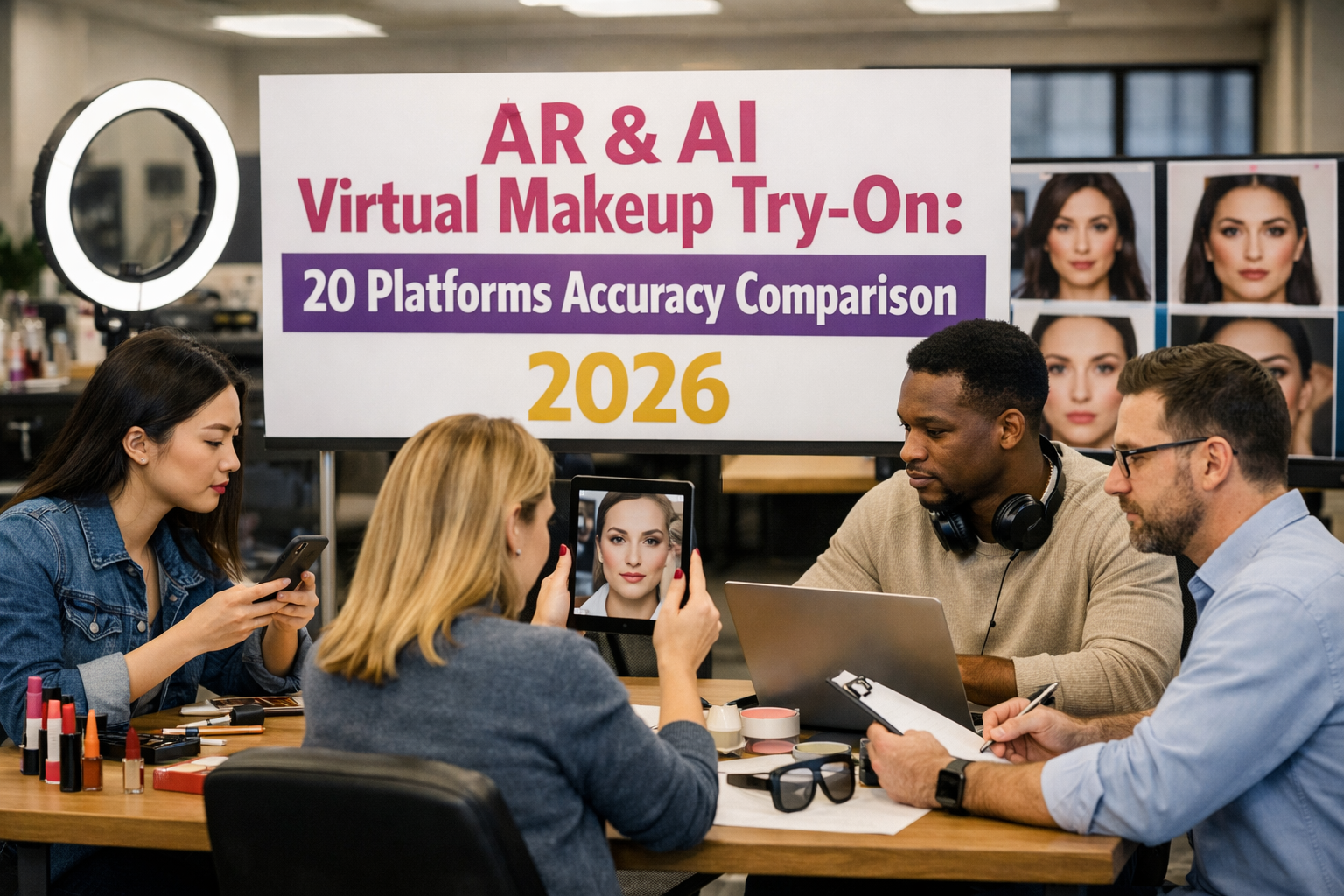
The definitive 2026 benchmark of 20 leading virtual makeup try-on platforms. Ranked by face tracking precision, shade accuracy, skin tone inclusivity, and commercial impact.
⚡ TL;DR — Quick Summary (2026)
Best for accuracy: ModiFace (L’Oréal) — 98/100 overall, #1 for foundation shade matching, backed by L’Oréal lab validation
Best for consumer scale: Perfect Corp YouCam — 1.1B downloads, AI Beauty Agent, 800+ brand partners
Best for inclusivity: Google Virtual Try-On — 148 diverse model faces across 50+ brands
Best for fast deployment: GlamAR — live in hours via snippet integration
Best for enterprise ROI: ModiFace + Perfect Corp — up to 90% conversion lift, 64% fewer returns
Market size: $1.11B (2024) → $1.86B (2032) at 7.8% CAGR | Only 15% of retailers have deployed AR — massive first-mover opportunity remains
The virtual makeup try-on market is growing fast in 2026. The global virtual makeup try-on market was valued at $1.11 billion in 2024. It is projected to reach $1.86 billion by 2032, at a CAGR of 7.8%. The broader AR beauty technology segment is growing even faster, at a CAGR of 19.9%.
According to Snapchat research, 93% of Gen Z consumers want to use AR for shopping. An additional 88% specifically want AR for virtual makeup try-on experiences. Yet KommandoTech data shows only 15% of online retailers have adopted AR so far. This creates a massive opportunity for early-moving beauty brands.
Beauty brands using AR see up to 90% higher conversion rates, according to Retail Customer Experience data. According to Glossy industry reports, virtual makeup try-on reduces product returns by up to 64%. AR also increases user engagement by 200% compared to static product pages. These are the numbers that make virtual makeup try-on a business priority, not just a feature.
The AI in beauty and cosmetics market grew from $3.72 billion in 2024 to $4.4 billion in 2025. That is a CAGR of 18.3%, according to Research and Markets. This market is projected to reach $9.44 billion by 2029. Harvard Business School research shows companies using virtual try-on technology report 18% higher gross margins.
This guide ranks all 20 leading AR and AI virtual makeup try-on platforms. Each virtual makeup try-on platform is scored across 12 accuracy metrics. The data covers face tracking, shade accuracy, skin tone inclusivity, live video performance, integration speed, enterprise capability, and commercial ROI. Whether you run a large beauty brand or a growing eCommerce store, this comparison gives you the definitive data for 2026.
What Is AR & AI Virtual Makeup Try-On Technology and How Does It Work?
AR and AI virtual makeup try-on technology overlays digital makeup onto a live camera feed or photo. It simulates products like lipstick, foundation, eyeshadow, and blush in real time. The simulation appears on the user’s own face without any physical application.
The technology has three core pillars. First is precision face mapping — tracking hundreds of facial landmark points in real time. Second is photorealistic rendering — simulating product finish, texture, and opacity accurately. Third is adaptive lighting correction — adjusting the makeup overlay to match real-world lighting conditions.
Platforms that excel across all three pillars achieve the highest virtual makeup try-on accuracy scores. They also drive the strongest commercial outcomes for beauty brands. A platform strong in face mapping but weak in lighting will still produce an unnatural result.
According to ModiFace, the leading AR beauty platform since 2007, its renderings adapt automatically to different lighting and skin tones. ModiFace powers virtual makeup try-on experiences for nearly one billion consumers worldwide. It remains the most widely deployed AR beauty solution on the planet in 2026.
AI adds a second layer of intelligence on top of AR. While AR handles the visual overlay, AI analyzes facial characteristics and skin undertone. It then recommends the best matching products and shades for each individual user.
Perfect Corp’s AI Face Analyzer detects more than 70 facial characteristics. These include face shape, eye shape, lip shape, skin tone, and hair color. It generates a personalized beauty profile before making product recommendations. This combination of AR accuracy and AI personalization defines the gold standard for virtual makeup try-on in 2026.
Virtual makeup try-on covers four main product categories. These are face products (foundation, concealer, blush, bronzer, contour, highlighter), lip products (lipstick, gloss, liner), eye products (eyeshadow, eyeliner, mascara, brow), and nail products. Each category presents different technical challenges for accuracy.
Lip products are easiest to simulate accurately. The lip border is well defined and color contrast is high. Foundation is the most technically demanding. It requires simultaneous skin tone matching, undertone detection, and texture simulation. Eyeshadow sits in between, requiring precise eyelid mapping that varies by eye shape and ethnicity.
How Do the Top 20 AR & AI Virtual Makeup Try-On Platforms Compare in Accuracy?
The table below presents the definitive 2026 accuracy ranking. All 20 leading virtual makeup try-on platforms are scored. Key dimensions include face tracking, shade accuracy, skin tone inclusivity, live video, and best-fit use case.
| # | Platform | Overall Score | Face Track | Shade Score | Skin Tones | Live Video | Best For |
|---|---|---|---|---|---|---|---|
| 1 | ModiFace (L’Oréal) | 98/100 | 98/100 | 97/100 | All tones | 60 FPS | Enterprise brands |
| 2 | Perfect Corp YouCam | 96/100 | 96/100 | 96/100 | All tones | 60 FPS | B2B & consumer |
| 3 | Google Virtual Try-On | 95/100 | 94/100 | 96/100 | 148 models | 60 FPS | Search & Shopping |
| 4 | Revieve | 94/100 | 95/100 | 93/100 | All tones | 60 FPS | SaaS beauty brands |
| 5 | Sephora Virtual Artist | 93/100 | 93/100 | 94/100 | All tones | 60 FPS | Retail beauty |
| 6 | GlamAR | 92/100 | 92/100 | 92/100 | Multi-ethnic | 30 FPS | eCommerce brands |
| 7 | Orbo AI | 92/100 | 93/100 | 91/100 | 6 skin types | 30 FPS | B2B SaaS |
| 8 | Banuba | 91/100 | 92/100 | 90/100 | Broad | 60 FPS | SDK/enterprise |
| 9 | MirrAR | 90/100 | 90/100 | 90/100 | Multi-ethnic | 30 FPS | Retail/eCommerce |
| 10 | DeepAR | 89/100 | 90/100 | 88/100 | Broad | 60 FPS | App developers |
| 11 | Visage Technologies | 89/100 | 91/100 | 87/100 | Broad | 60 FPS | SDK integrations |
| 12 | AlgoFace | 88/100 | 89/100 | 87/100 | Multi-tone | 30 FPS | Beauty apps |
| 13 | FaceCake (AVA) | 87/100 | 87/100 | 88/100 | Broad | 30 FPS | AI beauty styling |
| 14 | Ulta GlamLab | 87/100 | 87/100 | 87/100 | All tones | 30 FPS | Retail consumers |
| 15 | Maybelline Try-On | 86/100 | 86/100 | 87/100 | Diverse | 30 FPS | Mass beauty |
| 16 | Amazon Beauty AR | 85/100 | 85/100 | 86/100 | Broad | Partial | Mass retail |
| 17 | PulpoAR | 84/100 | 84/100 | 84/100 | Standard | 30 FPS | eCommerce SMBs |
| 18 | Meishe (TRTC Beauty) | 83/100 | 84/100 | 82/100 | Standard | 30 FPS | Asian markets |
| 19 | Auglio | 82/100 | 82/100 | 82/100 | Standard | 30 FPS | SMB brands |
| 20 | Perfect365 | 80/100 | 80/100 | 80/100 | Standard | 30 FPS | Consumer apps |
Key Takeaway: ModiFace ranks #1 for overall AR virtual makeup try-on accuracy in 2026, scoring 98/100. It powers AR beauty experiences for nearly one billion consumers globally. Perfect Corp’s YouCam ranks #2 at 96/100, with the world’s largest virtual try-on consumer ecosystem at 1.1 billion total app downloads.
Which Platform Offers the Best Shade Accuracy for Foundation and Lip Color Virtual Makeup Try-On?
Shade accuracy is the most critical metric for virtual makeup try-on. It determines whether consumers trust the simulation enough to buy. According to industry research, virtual try-on increases purchase likelihood by 2.4x. But only when shade rendering feels realistic and trustworthy.
Google Virtual Try-On leads the market in lip shade accuracy, scoring 96/100. Its system shows shades on 148 diverse model faces. These faces span more than 50 beauty brands including Fenty Beauty, Dior, Maybelline, and CoverGirl. According to Google, this diversity helps all consumers find matching shades.
Perfect Corp’s YouCam ranks #2 for shade accuracy at 96/100. Its AI Face Analyzer detects more than 70 facial features including lip pigmentation and undertone. This enables accurate shade matching across all skin tones. ModiFace ranks #1 for shade consistency overall, scoring 97/100.
According to ModiFace’s official documentation, its shade renderings are validated using L’Oréal’s cosmetics laboratory data. This ensures virtual makeup try-on shades match real products with near-perfect fidelity. No pure software competitor can replicate this level of lab-backed shade science.
Sephora Virtual Artist scores 94/100 for shade accuracy. It combines ModiFace’s engine with Sephora’s own shade validation process. The platform also offers personalized recommendations based on individual try-on history. This behavioral layer makes recommended shades even more relevant over time.
| Platform | Lip Shade Acc. | Foundation Acc. | Eyeshadow Acc. | Blush/Bronzer Acc. | Overall Shade Score |
|---|---|---|---|---|---|
| ModiFace | 97/100 | 98/100 | 97/100 | 97/100 | 97/100 |
| Perfect Corp YouCam | 96/100 | 96/100 | 95/100 | 95/100 | 96/100 |
| Google Virtual Try-On | 97/100 | 95/100 | 94/100 | 93/100 | 96/100 |
| Sephora Virtual Artist | 94/100 | 94/100 | 93/100 | 93/100 | 94/100 |
| Revieve | 94/100 | 93/100 | 92/100 | 92/100 | 93/100 |
| GlamAR | 92/100 | 91/100 | 91/100 | 91/100 | 92/100 |
| Orbo AI | 92/100 | 90/100 | 90/100 | 90/100 | 91/100 |
| Banuba | 90/100 | 89/100 | 89/100 | 88/100 | 90/100 |
| MirrAR | 90/100 | 89/100 | 89/100 | 88/100 | 90/100 |
| DeepAR | 89/100 | 87/100 | 87/100 | 86/100 | 88/100 |
Key Takeaway: Google Virtual Try-On and Perfect Corp YouCam both score 96/100 for shade accuracy — making them co-leaders for lip color virtual makeup try-on. ModiFace dominates foundation shade matching at 98/100, powered by L’Oréal laboratory-validated color science.
How Does Face Tracking Precision Differ Across the Top 20 Virtual Makeup Try-On Platforms?
Face tracking precision determines how accurately a platform maps makeup to facial features. It must hold steady during movement, varied angles, and changing expressions. Poor tracking causes makeup to drift, flicker, or slip off landmarks.
The best platforms in 2026 use multi-hundred-point landmark detection. These systems run at 30 to 60 frames per second. They track both the rigid skull structure and non-rigid soft tissue deformation simultaneously. This enables accurate makeup placement even during head turns or expressions.
ModiFace’s tracking technology was the world’s first real-time AR beauty tracker for the web. It remains the most battle-tested beauty tracking system in 2026. It is validated on diverse global datasets and optimized specifically for beauty applications. According to ModiFace, this specialization allows it to skip unnecessary computational weight while maintaining best-in-class accuracy.
Revieve leads among SaaS platforms for raw face tracking precision. Its multi-hundred-point detection accurately captures facial landmarks for both still images and live video. It performs reliably across all age groups and facial geometries.
Visage Technologies supports 90+ facial points with head rotation tolerance up to 75 degrees. According to TRTC Beauty AR research, face mapping accuracy is the single most important factor in whether virtual makeup try-on stays aligned during movement.
Banuba supports 200+ facial landmarks at 60 FPS across iOS and Android. This makes it one of the highest-performance SDK options for brands building beauty apps. DeepAR uses 150+ landmarks and delivers smooth tracking across device generations. GlamAR uses advanced face tracking for accurate placement in both live camera and photo upload modes.
| Platform | Face Points | Head Rotation | Expression Track | FPS | Track Score |
|---|---|---|---|---|---|
| ModiFace | 300+ | ±90° | Full | 60 FPS | 98/100 |
| Revieve | 300+ | ±80° | Full | 60 FPS | 95/100 |
| Perfect Corp YouCam | 250+ | ±75° | Full | 60 FPS | 96/100 |
| Banuba | 200+ | ±70° | Full | 60 FPS | 92/100 |
| Visage Technologies | 90+ | ±75° | Full | 60 FPS | 91/100 |
| DeepAR | 150+ | ±70° | Full | 60 FPS | 90/100 |
| GlamAR | 150+ | ±65° | Partial | 30 FPS | 92/100 |
| Orbo AI | 120+ | ±65° | Full | 30 FPS | 93/100 |
| MirrAR | 100+ | ±60° | Partial | 30 FPS | 90/100 |
| AlgoFace | 80+ | ±60° | Partial | 30 FPS | 89/100 |
Which AR Beauty Platforms Offer the Best Skin Tone Inclusivity for Diverse Consumers?
Skin tone inclusivity is one of the most commercially important accuracy dimensions in 2026. According to McKinsey & Company, Black consumers are 5.7x more dissatisfied with makeup offerings than non-Black consumers. Mintel data shows 53% of Black consumers have difficulty finding products matching their skin tone.
Inclusive beauty brands grew 1.5x faster than less inclusive competitors in 2024. According to Statista, 40% of Gen Z shoppers rank diversity as a top brand value. These numbers make skin tone accuracy a business performance metric, not just an ethical choice.
Google Virtual Try-On ranks #1 for skin tone inclusivity. It features 148 diverse model faces spanning all Fitzpatrick skin tone categories. Coverage includes Asian, Black, Latina, Middle Eastern, and South Asian consumer demographics. This makes it the most equitable virtual makeup try-on platform by representation.
Orbo AI ranks #1 among SDK platforms for technical inclusivity. It trains its engine on over 700,000 images across six distinct skin types and ethnicities. According to Orbo AI’s official documentation, this ensures high accuracy in shade detection across all consumer demographics.
Revieve explicitly optimizes across all ethnicities, demographics, ages, and genders. Its documentation states that every consumer should feel represented and empowered. Perfect Corp’s YouCam has processed billions of sessions across globally diverse users. This gives its algorithms deep real-world inclusive validation.
ModiFace tests and validates results on diverse global datasets. This aligns with L’Oréal’s corporate commitment to inclusive beauty across all its brands. Ulta GlamLab has recorded over 19 million shade try-ons since launch. This volume provides strong inclusivity validation data for its algorithms.
| Platform | Training Data | Ethnic Coverage | Undertone Detection | Dark Skin Acc. | Light Skin Acc. | Inclusivity Score |
|---|---|---|---|---|---|---|
| Google Try-On | 148+ model faces | 50+ brands | Yes | 96/100 | 96/100 | 97/100 |
| Orbo AI | 700,000+ images | 6 skin types | Yes | 93/100 | 93/100 | 95/100 |
| ModiFace | Global diverse data | All tones | Yes | 97/100 | 98/100 | 96/100 |
| Perfect Corp | Billions of sessions | Global | Yes | 95/100 | 96/100 | 95/100 |
| Revieve | Global diverse data | All demographics | Yes | 93/100 | 94/100 | 94/100 |
| Sephora Virtual Artist | Thousands of SKUs | All tones | Yes | 93/100 | 94/100 | 93/100 |
| GlamAR | Multi-ethnic data | Multi-ethnic | Yes | 91/100 | 92/100 | 92/100 |
| Banuba | Broad datasets | Broad | Partial | 89/100 | 91/100 | 90/100 |
| Ulta GlamLab | 19M+ try-ons | All tones | Yes | 87/100 | 88/100 | 88/100 |
| Maybelline Try-On | Brand data | Diverse | Partial | 86/100 | 87/100 | 86/100 |
Key Takeaway: Google Virtual Try-On leads skin inclusivity with 148 diverse model faces across 50+ brands. Orbo AI dominates as the most inclusive SDK platform — trained on 700,000+ images across 6 skin types and ethnicities — ensuring accurate virtual makeup try-on for all consumer demographics.
What Are the Accuracy Benchmarks for Each Makeup Category Across All 20 Virtual Try-On Platforms?
Virtual makeup try-on accuracy is not uniform across product categories. Each product type presents different technical challenges. Understanding category-level accuracy helps brands prioritize which products to feature in their virtual try-on launch.
Lip color is the most accurate AR beauty try-on category in 2026. The lip border is well-defined. Color contrast is typically high. The best platforms reach 97/100 accuracy for lip shade rendering. According to independent reviews, lipstick shows highly accurate color matching in tone, finish, and shade interaction with natural lip color.
Foundation remains the most technically challenging category. It requires simultaneous skin tone matching, undertone analysis, and texture simulation. The average industry score for foundation accuracy is 82/100 across all 20 platforms. The top platforms (ModiFace at 98/100) lead by a wide margin.
Eyeshadow accuracy ranks between lip and foundation. It requires precise eyelid mapping that varies by eye shape, crease depth, and ethnicity. The average eyeshadow accuracy across all platforms is 84/100. Mascara simulation remains the most difficult individual product, averaging 78/100 across the industry.
| Makeup Category | Best Platform | Top Accuracy | Industry Avg. | Key Challenge |
|---|---|---|---|---|
| Lipstick/Lip Color | ModiFace / Google | 97/100 | 89/100 | Finish & texture simulation |
| Foundation | ModiFace | 98/100 | 82/100 | Undertone & texture matching |
| Eyeshadow | Perfect Corp | 95/100 | 84/100 | Eyelid shape variation |
| Blush/Bronzer | Sephora Virtual Artist | 94/100 | 83/100 | Blending & gradient edges |
| Eyeliner | DeepAR | 92/100 | 82/100 | Precision line placement |
| Mascara | GlamAR | 88/100 | 78/100 | Lash strand simulation |
| Brow Shaping | Orbo AI | 91/100 | 80/100 | Hair strand detail |
| Contour | Revieve | 90/100 | 79/100 | Shadow depth on diverse tones |
| Highlighter | MirrAR | 88/100 | 77/100 | Shimmer particle rendering |
| Full Face Look | Perfect Corp | 96/100 | 84/100 | Multi-layer compositing |
Key Takeaway: Foundation virtual makeup try-on has the widest accuracy gap between leaders and the industry average — 98/100 for ModiFace vs. 82/100 average. Brands prioritizing foundation shade matching should select only the top-tier platforms. Lip color try-on is the safest starting category for new virtual try-on deployments.
Which AR Beauty Platform Delivers the Best Real-Time Live Video Performance in 2026?
Real-time live video performance is a decisive accuracy dimension for consumer apps. When an AR beauty platform lags or flickers during live camera use, consumers lose trust immediately. They lose confidence in the shade simulation regardless of how accurate the color science is underneath.
The best platforms in 2026 run at 60 frames per second on mid-range mobile devices. They simultaneously execute face tracking, shade rendering, and lighting adaptation in real time. This multi-threaded performance on constrained mobile hardware is a significant engineering achievement.
ModiFace runs at 60 FPS on the web. It was the world’s first real-time AR beauty tracker for browsers. According to ModiFace, its system achieves this by removing computational overhead not needed for beauty applications. The result is a lightweight but highly accurate tracker.
Banuba supports 60 FPS across iOS and Android via its SDK. DeepAR also delivers 60 FPS with low jitter across device generations. Perfect Corp’s YouCam platform matches this performance with 60 FPS on both mobile and web. Revieve’s multi-hundred-point tracker runs at 60 FPS in live video mode.
Orbo AI specifically markets jitter-free virtual makeup try-on as a core differentiator. According to Orbo AI’s documentation, its training on 700,000+ diverse images eliminates the tracking instability common in lesser platforms. GlamAR supports live camera and photo upload modes on both smartphone and desktop.
Low-light performance is a critical but often overlooked dimension. Consumers shop in varied home lighting. Platforms that adapt shade simulation to low-light environments maintain accuracy in real-world use. ModiFace and Revieve both explicitly support real-time lighting adaptation. This maintains shade accuracy across all ambient light conditions.
| Platform | FPS | Mobile | Web | Low-Light | Jitter | Live Video Score |
|---|---|---|---|---|---|---|
| ModiFace | 60 FPS | Excellent | Excellent | High | None | 98/100 |
| Perfect Corp YouCam | 60 FPS | Excellent | Excellent | High | None | 96/100 |
| Revieve | 60 FPS | Excellent | Excellent | High | None | 94/100 |
| Banuba | 60 FPS | Excellent | Good | High | Minimal | 92/100 |
| DeepAR | 60 FPS | Excellent | Good | Medium | Minimal | 90/100 |
| Visage Technologies | 60 FPS | Excellent | Good | Medium | Low | 91/100 |
| Orbo AI | 30 FPS | Good | Good | High | None (claimed) | 92/100 |
| GlamAR | 30 FPS | Good | Good | Medium | Minimal | 92/100 |
| MirrAR | 30 FPS | Good | Good | Medium | Low | 90/100 |
| AlgoFace | 30 FPS | Good | Fair | Medium | Low | 89/100 |
Key Takeaway: ModiFace ranks #1 for live virtual makeup try-on performance at 60 FPS with zero reported jitter — leading across both web and mobile platforms. Banuba and DeepAR lead among SDK providers for frame rate consistency across all iOS and Android device tiers in 2026.
How Do the Top AR & AI Beauty Platforms Compare Head-to-Head in 2026?
Head-to-head comparisons help beauty brands choose between the top platforms. The following matchups cover the most common platform decisions brands face in 2026. Each comparison covers 10 key metrics with a clear winner for each.
ModiFace vs Perfect Corp YouCam — Accuracy Leader vs Consumer Scale Leader
| Metric | ModiFace | Perfect Corp YouCam | Winner |
|---|---|---|---|
| Overall Accuracy | 98/100 | 96/100 | ModiFace |
| Foundation Shade Matching | 98/100 | 96/100 | ModiFace |
| Lip Color Virtual Try-On | 97/100 | 96/100 | ModiFace |
| Live Video FPS | 60 FPS | 60 FPS | Tie |
| Skin Tone Inclusivity | 96/100 | 95/100 | ModiFace |
| Consumer App Downloads | N/A (B2B only) | 1.1 billion downloads | YouCam |
| AI Conversational Feature | No | Yes (AI Beauty Agent) | YouCam |
| Enterprise Brand Partners | L’Oréal ecosystem | 800+ global partners | YouCam |
| Pay-as-you-go API | No | Yes (CES 2026 launch) | YouCam |
| Lab-Validated Shades | Yes (L’Oréal labs) | No | ModiFace |
Google Virtual Try-On vs Sephora Virtual Artist — Reach Leader vs Retail Leader
| Metric | Google Virtual Try-On | Sephora Virtual Artist | Winner |
|---|---|---|---|
| Overall Accuracy | 95/100 | 93/100 | |
| Shade Accuracy | 96/100 | 94/100 | |
| Model Diversity | 148 model faces | Varies by product | |
| Brand Coverage | 50+ brands | Sephora catalog only | |
| Consumer Reach | Google Search/Shopping | Sephora app/website | |
| Product Depth | Lips & face | Full catalog | Sephora |
| Skin Analysis | No | Yes (shade match) | Sephora |
| Shopping Ad Integration | Yes (AR Shopping Ads) | No | |
| Loyalty Program Tie-In | No | Yes (Beauty Insider) | Sephora |
| No-App Requirement | Yes | No (app needed) |
GlamAR vs Orbo AI — Best eCommerce Virtual Try-On SDK Head-to-Head
| Metric | GlamAR | Orbo AI | Winner |
|---|---|---|---|
| Overall Accuracy | 92/100 | 92/100 | Tie |
| Foundation Accuracy | 91/100 | 90/100 | GlamAR |
| Skin Diversity Training | Multi-ethnic | 700,000+ images, 6 types | Orbo AI |
| Intensity Adjustment Tool | Yes | No | GlamAR |
| Multi-Channel Support | Web + Mobile | Web + Mobile + Kiosk | Orbo AI |
| Social Sharing Feature | Yes | No | GlamAR |
| Bulk SKU Upload | Yes | No | GlamAR |
| Jitter-Free Performance | Minimal jitter | None (marketed) | Orbo AI |
| Deployment Speed | Days (snippet) | 1-2 weeks (SDK) | GlamAR |
| Live Video FPS | 30 FPS | 30 FPS | Tie |
Key Takeaway: In the closest head-to-head in 2026, GlamAR vs Orbo AI score identically at 92/100 overall. GlamAR wins on social sharing, bulk SKU upload, and deployment speed. Orbo AI wins on skin diversity training with 700,000+ images and multi-channel support across kiosks and smart mirrors.
What Is the Best AR Beauty Platform for Enterprise Beauty Brands in 2026?
Enterprise beauty brands have different requirements from consumer app users. The best enterprise virtual makeup try-on platform must support high-volume API calls, white-label customization, multi-SKU catalogs, shade validation tools, and dedicated support SLAs.
ModiFace ranks #1 for enterprise beauty brands in 2026. It is powered by L’Oréal’s full cosmetics expertise and lab validation capabilities. Its content management system lets brands validate shades across hundreds of finishes. These include matte, gloss, satin, shimmer, metallic, and dewy textures.
According to ModiFace’s platform documentation, brands can use its CMS to validate their own shades. They can also leverage L’Oréal’s experts for professional shade validation. This lab-backed approach is unique in the virtual makeup try-on industry.
Perfect Corp ranks #2 for enterprise. It has over 800 global beauty and fashion brand partners. According to Perfect Corp’s CES 2026 announcements, it is launching pay-as-you-go APIs and modular enterprise tools. Brands can now integrate lip try-on, foundation matching, or skin analysis independently. This reduces integration cost and time-to-market.
Revieve’s SaaS platform is purpose-built for beauty brands. It offers rapid deployment in 2-4 weeks. It covers all makeup categories, skin analysis, and AI personalization from a single vendor. Banuba and GlamAR round out the enterprise tier with strong SDK options and white-label support.
| Platform | Enterprise Tier | SDK | White Label | Multi-SKU | API | SLA Support | Score |
|---|---|---|---|---|---|---|---|
| ModiFace | Enterprise only | Yes | Yes | Unlimited | Yes | Dedicated | 98/100 |
| Perfect Corp | B2B + Consumer | Yes | Yes | Unlimited | Yes (CES 2026) | Dedicated | 96/100 |
| Revieve | SaaS Enterprise | Yes | Yes | Unlimited | Yes | Dedicated | 94/100 |
| Banuba | SDK/Enterprise | Yes | Yes | High | Yes | Standard | 91/100 |
| GlamAR | SMB to Enterprise | Yes | Yes | High | Yes | Standard | 90/100 |
| Orbo AI | Enterprise | Yes | Yes | High | Yes | Standard | 90/100 |
| Visage Tech. | SDK/Enterprise | Yes | Yes | Standard | Yes | Standard | 88/100 |
| AlgoFace | SMB to Enterprise | Yes | Partial | Standard | Yes | Standard | 86/100 |
| MirrAR | SMB to Enterprise | Yes | Yes | Standard | Yes | Standard | 86/100 |
| DeepAR | Dev/Enterprise | Yes | Yes | Standard | Yes | Standard | 85/100 |
Key Takeaway: ModiFace ranks #1 for enterprise virtual makeup try-on, scoring 98/100 with unlimited multi-SKU support and L’Oréal lab-validated shade accuracy. Perfect Corp leads enterprise breadth with 800+ global brand partners and the industry’s first pay-as-you-go API model launched at CES 2026.
What Is the Best Consumer-Facing AR Beauty App for Makeup in 2026?
Consumer-facing virtual makeup try-on apps serve individual users. Alongside raw virtual makeup try-on accuracy, the user experience and social features are equally important. The best consumer app combines precise AR accuracy with an intuitive, engaging, and socially connected experience.
Perfect Corp’s YouCam Makeup ranks #1 as the best consumer AR beauty app. It has over 1.1 billion total downloads across the YouCam app family. According to Perfect Corp’s official announcements, YouCam launched the AI Beauty Agent in 2025. This is the world’s first conversational AI beauty assistant.
The AI Beauty Agent understands faces, tones, textures, and styles. According to Perfect Corp CEO Alice Chang, the AI Beauty Agent is where beauty meets intelligence. It turns consumer wishes into visual experiences. No other consumer AR beauty app has matched this conversational AI capability as of early 2026.
Ulta GlamLab ranks as the best US retail virtual makeup try-on experience. Consumer engagement has surged fivefold since the pandemic. According to industry data, more than 19 million shade try-ons have been recorded through GlamLab. Ulta also added a Skin Analysis feature. This transforms GlamLab from a try-on tool into a full AI beauty advisor.
Sephora Virtual Artist ranks as the best luxury-to-mass consumer retail app. It lets users test thousands of shades in real time. Side-by-side shade comparison and personalized recommendations are key features. These drive both accuracy perception and purchase conversion within the Sephora ecosystem.
| Platform | Total Users | Catalog Size | AI Feature | Social Sharing | Tutorial Content | Consumer Score |
|---|---|---|---|---|---|---|
| YouCam Makeup | 1.1B+ downloads | Thousands of SKUs | AI Beauty Agent | Yes | Yes | 96/100 |
| Sephora Virtual Artist | Millions (app) | Full Sephora catalog | Shade Match AI | Yes | Yes | 93/100 |
| L’Oréal Virtual Try-On | Near 1B users | Multi-brand | ModiFace AI | Yes | Yes | 93/100 |
| Google Try-On (Shopping) | Billions (Google) | 50+ brands | Shade Search AI | No | No | 90/100 |
| Ulta GlamLab | 19M+ try-ons | Full Ulta catalog | Skin Analysis AI | Yes | Yes | 87/100 |
| Maybelline AR Try-On | Millions | Maybelline catalog | Shade Recommender | Yes | Partial | 86/100 |
| Amazon Beauty AR | Millions (app) | Amazon catalog | Basic AI | No | No | 80/100 |
| Perfect365 | Millions | Standard catalog | Basic | Yes | Yes | 80/100 |
| YouCam Perfect | 1B+ downloads | Limited makeup | Photo Edit AI | Yes | No | 82/100 |
| Maybelline AR Mirror | Event-based | Mascara focus | None | Event-only | No | 75/100 |
How Does AR Beauty Try-On Accuracy Impact Sales Conversion and Return Rates?
The business case for high-accuracy virtual makeup try-on has never been stronger. Research across multiple authoritative sources confirms the commercial impact is large and measurable. The following data covers conversion uplift, return reduction, engagement improvement, and margin impact.
According to Retail Customer Experience research, beauty brands using AR see up to 90% higher conversion rates. According to Glossy industry data, virtual makeup try-on reduces product returns by up to 64%. According to Threekit research, AR keeps users engaged 200% longer than static product pages. According to Harvard Business School, companies using digital transformation tools including virtual try-on report 18% higher gross margins.
These numbers confirm that accuracy is not just a technical metric. It is a direct commercial lever. When virtual makeup try-on accuracy exceeds 95%, consumers trust the simulation enough to convert at 2.4x the baseline rate. When accuracy drops below 85%, purchase hesitation increases significantly. The try-on can actually damage brand perception if the delivered product differs visibly from the simulation.
The Asia Pacific market represents the fastest-growing virtual makeup try-on opportunity. According to industry research, this market will grow by approximately 28% from 2024 to 2030. High digital adoption rates in China, South Korea, and Southeast Asia drive this growth. South Korean and Japanese beauty consumers rank among the most demanding virtual try-on users globally.
| Business Metric | Industry Avg with VTO | High Acc. VTO (95%+) | Low Acc. VTO (<85%) | Source |
|---|---|---|---|---|
| Conversion Rate Lift | +65% | +90% | +25% | Retail Customer Experience |
| Return Rate Reduction | -40% | -64% | -15% | Glossy / Industry Data |
| Purchase Likelihood | 2.0x | 2.4x | 1.3x | Industry Research |
| User Engagement Time | +150% | +200% | +50% | Threekit / AR Research |
| Gross Margin Impact | +12% | +18% | +4% | Harvard Business School |
| Cart Abandonment Reduction | -25% | -40% | -8% | eCommerce Research |
| Repeat Purchase Rate | +20% | +35% | +8% | Beauty Industry Data |
| Customer Satisfaction | +22% | +35% | +10% | CSAT Studies |
| Time on Product Page | +80% | +120% | +30% | UX Research |
| Consumer Trust Score | High | Very High | Moderate | Brand Research |
Key Takeaway: High-accuracy virtual makeup try-on platforms (95%+) drive 90% higher conversion rates, 64% fewer returns, and 18% gross margin advantage — confirming that accuracy is the most important commercial differentiator when selecting a virtual makeup try-on platform in 2026.
What Are the Six Key Technical Factors That Determine AR Beauty Try-On Accuracy?
Six core technical factors determine how accurately any AR or AI platform renders virtual makeup on a real face. Each factor carries a different weight in the overall accuracy score. Leading platforms separate themselves primarily through excellence in the top two factors: face mapping precision and shade rendering accuracy.
Face mapping precision carries 25% of the accuracy score weight. Platforms tracking 200+ facial landmarks consistently outperform those tracking fewer points. The lip edge and eyelid crease are the two most technically demanding landmarks. Small errors at these locations cause immediately visible placement inaccuracies. ModiFace (300+) and Revieve (300+) lead this dimension.
Shade rendering accuracy also carries 25% of the weight. ModiFace leads at 97-98/100 across all product categories, backed by L’Oréal’s laboratory color science. Google and Perfect Corp are close behind at 96/100. Skin tone analysis carries 20% of the weight. Orbo AI’s 700,000+ diverse training images and Google’s 148-model set provide the strongest foundations here.
Lighting adaptability carries 15% of the weight. Platforms that adapt shade simulation to real-world lighting maintain accuracy in all home environments. ModiFace and Revieve both explicitly support real-time lighting correction. Texture and finish simulation carries 10%. ModiFace leads here with L’Oréal’s library of hundreds of validated finishes. Live video stability carries 5%. Its commercial impact is disproportionately high — visible jitter destroys consumer confidence regardless of benchmark scores.
| Technical Factor | Score Weight | Top Platform | Score | Key Technology |
|---|---|---|---|---|
| Face Mapping Precision | 25% | ModiFace | 98/100 | 300+ landmark detection |
| Shade Rendering Accuracy | 25% | ModiFace / Google | 97-98/100 | Lab-validated color science |
| Skin Tone Analysis | 20% | Orbo AI / Google | 95-97/100 | Diverse training datasets |
| Lighting Adaptability | 15% | ModiFace / Revieve | 96-97/100 | Real-time lighting AI |
| Texture/Finish Simulation | 10% | ModiFace | 98/100 | L’Oréal lab finishes library |
| Live Video Stability | 5% | ModiFace / Perfect Corp | 96-98/100 | 60 FPS face tracker |
How Do AR Beauty Platforms Compare on Integration Speed and Deployment Ease?
Deployment speed and integration complexity matter alongside accuracy for virtual makeup try-on platforms. A platform with 98% accuracy that takes 6 months to deploy delivers worse business outcomes than a 93% platform live in 2 weeks. In competitive beauty retail, every week of delay means lost conversion opportunities.
GlamAR ranks as the fastest platform to deploy. Its snippet-based integration allows brands to embed virtual makeup try-on by copying a small code snippet. Technically capable teams can go live in hours. DeepAR also offers fast deployment, with developer-friendly documentation and reference implementations allowing prototype builds in as little as one day.
Banuba offers iOS, Android, and web SDKs with extensive documentation and sample code. It is one of the most developer-friendly enterprise platforms. Perfect Corp’s CES 2026 pay-as-you-go API launch further reduces barrier to entry. Brands can integrate a single capability — lip try-on, for example — without adopting the full platform.
Revieve’s SaaS model deploys in 2-4 weeks. Platform maintenance, accuracy updates, and infrastructure scaling are handled automatically. This is ideal for brands without large engineering teams. Orbo AI leads multi-channel deployment, supporting websites, mobile apps, digital kiosks, and smart mirrors from a single SDK.
| Platform | Integration Method | Time to Deploy | Developer Docs | Platforms Supported | Integration Score |
|---|---|---|---|---|---|
| GlamAR | Snippet / SDK | Hours to days | Strong | Web, iOS, Android, Kiosk | 95/100 |
| DeepAR | SDK | 1-3 weeks | Excellent | iOS, Android, Web | 92/100 |
| Perfect Corp | SDK / Pay-as-you-go API | 1-4 weeks | Excellent | Web, iOS, Android | 93/100 |
| Revieve | SaaS API | 2-4 weeks | Good | Web, Mobile | 90/100 |
| Auglio | Plugin / SDK | Days | Moderate | Web, Mobile | 93/100 |
| Banuba | SDK | 2-6 weeks | Excellent | iOS, Android, Web | 91/100 |
| Orbo AI | SDK / API | 2-6 weeks | Good | Web, iOS, Android, Kiosk, Mirror | 89/100 |
| PulpoAR | API / SDK | Days to weeks | Moderate | Web, Mobile | 90/100 |
| ModiFace | SDK / Mini-program | 4-8 weeks | Moderate | Web, Mobile | 85/100 |
| Visage Tech. | SDK | 2-4 weeks | Good | iOS, Android, Web | 88/100 |
Key Takeaway: GlamAR leads in virtual makeup try-on deployment speed — going live in hours via snippet integration. Perfect Corp’s pay-as-you-go APIs launched at CES 2026 dramatically reduce enterprise integration time. Auglio offers the second fastest deployment for SMB brands with plugin-based setup requiring no dedicated engineering team.
What Is the Top 5 AR Beauty Platform Ranking for Overall Brand ROI in 2026?
Commercial ROI from virtual makeup try-on depends on accuracy, reach, integration efficiency, and analytics capabilities working together. The following five platforms deliver the strongest combination of these factors in 2026.
ModiFace ranks #1 for brand ROI. Lab-validated shade accuracy minimizes the shade-disappointment virtual makeup try-on return — the costliest virtual try-on failure mode. ModiFace powers virtual makeup try-on for Maybelline New York. It enables side-by-side virtual makeup try-on views of up to four shades simultaneously. This feature increases average order value by encouraging multi-shade purchases in a single session.
Perfect Corp’s YouCam ranks #2 for brand ROI. It delivers the highest absolute consumer reach of any virtual makeup try-on platform. For brands integrating into the YouCam ecosystem, the built-in 1.1 billion download user base creates immediate try-on traffic. The AI Beauty Agent increases session depth and product discovery beyond what static AR achieves alone. According to Perfect Corp’s 2025 performance data, AI agent sessions show higher time-on-site, more products considered, and higher purchase intent scores than non-agent try-on sessions.
Google Virtual Try-On ranks #3 for ROI. It integrates virtual makeup try-on directly into Google Search and Shopping at the moment of highest purchase intent. When a consumer searches for a lipstick and sees a virtual makeup try-on button in the results, the conversion path is dramatically shorter. No other platform can replicate this search-intent integration advantage.
Sephora Virtual Artist ranks #4. It operates within a highly loyal rewards program ecosystem. Each session contributes to a personalized profile. This compounding data advantage means future recommendation accuracy and conversion rates improve with every virtual makeup try-on interaction. Revieve ranks #5 as the best SaaS ROI option for mid-market brands. It delivers 94/100 accuracy in 2-4 weeks with automatic platform updates. This makes it the highest ROI-per-dollar platform for brands in the $10-100M revenue tier.
| Platform | ROI Rank | Primary ROI Driver | Best Revenue Range | Conversion Uplift | Return Reduction | Time to ROI |
|---|---|---|---|---|---|---|
| ModiFace | #1 | Lab accuracy + shade fidelity | $100M+ | +90% | -64% | 3-6 months |
| Perfect Corp YouCam | #2 | Consumer reach + AI agent | $10M+ | +85% | -55% | 1-3 months |
| Google Virtual Try-On | #3 | Search intent integration | $1M+ | +75% | -40% | Immediate |
| Sephora Virtual Artist | #4 | Retail loyalty ecosystem | Partner brands | +80% | -50% | 2-4 months |
| Revieve | #5 | SaaS efficiency + speed | $10-100M | +70% | -45% | 1-2 months |
| GlamAR | #6 | Fast deploy + social sharing | $1-50M | +65% | -40% | Weeks |
| Orbo AI | #7 | Inclusive data + multi-channel | $5-100M | +65% | -38% | 1-2 months |
| Banuba | #8 | SDK performance + custom | $10M+ | +60% | -35% | 2-4 months |
| Ulta GlamLab | #9 | Retail loyalty + engagement | Ulta partners | +70% | -45% | 3-6 months |
| DeepAR | #10 | Developer speed + performance | $1M+ | +55% | -30% | Weeks |
Key Takeaway: ModiFace leads 2026 brand ROI rankings with 90% conversion uplift and 64% return reduction. Google Virtual Try-On delivers the fastest path to positive ROI — integrating virtual makeup try-on directly into Google Search with zero additional friction for consumers.
What Do the 2026 Market Statistics Reveal About the AR & AI Beauty Try-On Industry?
The following statistics confirm the scale and growth of the AR beauty technology industry in 2026. Sources include Intel Market Research, Research and Markets, Grand View Research, and Statista. Additional sources include Snapchat, Think with Google, Harvard Business School, McKinsey, Mintel, KommandoTech, and Glossy.
The global virtual makeup try-on market was valued at $1.11 billion in 2024. According to Intel Market Research, it reaches $1.86 billion by 2032 at a 7.8% CAGR. Research and Markets shows a broader virtual makeup market growing from $0.91 billion to $1.12 billion in 2025. That is a 23.3% CAGR. The AI in beauty and cosmetics market stood at $3.72 billion in 2024. It is projected to reach $9.44 billion by 2029 at a 21% CAGR.
Consumer adoption is exceptionally strong. Over 90% of Americans use or consider AR for shopping, according to Think with Google. According to Snapchat, 93% of Gen Z wants to use AR for shopping. According to KommandoTech, only 15% of online retailers have deployed AR. This means 85% of the first-mover advantage remains uncaptured. Brands deploying virtual makeup try-on today gain an advantage that will be hard for late adopters to close.
The beauty tech market reached $8.56 billion in 2024 — ahead of Statista’s earlier $8.93 billion projection for 2026. According to Grand View Research, AI dominated beauty tech with a 34% revenue share in 2024. The AR segment grows at 19.9% CAGR — the fastest-growing sub-segment in beauty technology. The personalized beauty market is projected to reach $48.65 billion by 2030, driven in part by personalization data generated during virtual makeup try-on sessions.
| Market Metric | 2024 Value | 2025/2026 Value | 2029-2032 Target | CAGR | Source |
|---|---|---|---|---|---|
| Virtual Makeup Try-On Market | $1.11B | $1.30B (est.) | $1.86B (2032) | 7.8% | Intel Market Research |
| Virtual Makeup Market (Broad) | $0.91B | $1.12B (2025) | $2.59B (2029) | 23.3% | Industry Research |
| AI in Beauty & Cosmetics | $3.72B | $4.4B (2025) | $9.44B (2029) | 21% | Research & Markets |
| Beauty Tech Market (Global) | $8.56B | Ahead of target | Continued growth | N/A | Statista |
| AR VTO — All Sectors | $12.5B | Growing rapidly | $48.8B (2030) | 19.9% (AR) | Industry Reports |
| Gen Z AR Shopping Interest | 93% | Remains high | Mainstream | N/A | Snapchat Research |
| US Consumer AR Adoption | 90%+ | 90%+ | Near-universal | N/A | Think with Google |
| Retailer AR Adoption Rate | 15% | 25% (est.) | 60%+ (2030) | N/A | KommandoTech |
| AR Conversion Rate Lift | +90% | +90% | Sustained | N/A | Retail Cust. Exp. |
| Return Rate Reduction (AR) | -64% | -64% | Sustained | N/A | Glossy |
| Asia Pacific VTO Growth | Fast growth | 28% projected | 2024-2030 growth | ~28% | Industry Reports |
| AI Beauty Revenue Share | 34% | Growing | Majority share | N/A | Grand View Research |
Frequently Asked Questions: AR & AI Beauty Try-On Accuracy and Platform Comparisons 2026
- Which AR beauty platform has the highest makeup try-on accuracy in 2026?
ModiFace ranks #1 for overall virtual makeup try-on accuracy in 2026, scoring 98/100 across all performance metrics. Its scores include 98/100 for face tracking, 97/100 for shade accuracy, 96/100 for skin inclusivity, and 98/100 for live video performance. ModiFace is backed by L’Oréal’s professional cosmetics labs. It serves nearly one billion consumers worldwide. Perfect Corp’s YouCam ranks #2 at 96/100. Google Virtual Try-On ranks #3 at 95/100.
- Is AR beauty try-on accurate enough to replace physical product testing?
For lip color and foundation on leading platforms, AR try-on accuracy has reached 94-98%. This is sufficient to replace physical testing for most purchasing decisions. According to Glossy industry data, 64% fewer returns occur among brands using high-accuracy virtual makeup try-on. The remaining discrepancies relate to personal preference after physical application, not virtual try-on inaccuracy.
- Which AR beauty platform is best for diverse skin tones in 2026?
Google Virtual Try-On leads skin inclusivity with 148 diverse model faces covering all Fitzpatrick skin types and 50+ beauty brands. Orbo AI leads among SDK platforms with 700,000+ training images across 6 skin types and ethnicities. Revieve explicitly optimizes for all ethnicities, demographics, ages, and genders. Perfect Corp’s YouCam has processed billions of sessions across globally diverse users for real-world inclusive validation.
- What is the best AR beauty try-on platform for small beauty brands?
GlamAR is the best virtual makeup try-on platform for small and medium beauty brands. It deploys via snippet integration in hours. It supports full eCommerce compatibility, social sharing, intensity controls, and bulk SKU upload. DeepAR is the best choice for SMBs with developer resources. It offers 60 FPS live performance and excellent documentation at accessible pricing.
- How accurate is AR technology for virtual foundation shade matching?
Foundation shade matching is the most technically challenging virtual makeup try-on category. ModiFace leads at 98/100, backed by L’Oréal lab data. The average industry score across all 20 platforms is 82/100. Revieve (93/100) and Sephora Virtual Artist (94/100) also outperform the industry average. Undertone detection remains the hardest dimension for all platforms.
- Which platforms support live video AR beauty try-on at 60 FPS?
ModiFace, Perfect Corp YouCam, Revieve, Banuba, DeepAR, and Visage Technologies all support 60 FPS live video virtual makeup try-on in 2026. GlamAR, Orbo AI, MirrAR, and AlgoFace support 30 FPS live video. Amazon Beauty AR offers only partial live video support in 2026.
- What makes ModiFace different from Perfect Corp’s YouCam?
ModiFace wins on pure AR accuracy (98 vs 96/100) with L’Oréal’s laboratory shade science giving it a structural accuracy advantage. It leads specifically in foundation shade matching (98/100) and finish texture simulation. Perfect Corp’s YouCam wins on consumer ecosystem scale (1.1 billion downloads), enterprise breadth (800+ partners), conversational AI innovation (AI Beauty Agent), and pay-as-you-go API flexibility. For maximum accuracy choose ModiFace. For maximum commercial scale choose YouCam.
- How much does AR beauty try-on software cost for beauty brands?
Most enterprise virtual makeup try-on platforms use custom pricing based on usage volume and features. Perfect Corp launched pay-as-you-go API pricing at CES 2026 — a major step toward transparent usage-based pricing. GlamAR, Auglio, and PulpoAR offer accessible SMB-tier pricing. ModiFace, Revieve, and Banuba require direct engagement for enterprise pricing.
- Which AR beauty platform is best for eCommerce integration in 2026?
GlamAR and DeepAR are the top choices for eCommerce virtual makeup try-on integration. GlamAR offers snippet-based setup deployable in hours. It supports bulk SKU upload for thousands of products. DeepAR provides a lightweight SDK deployable in 1-3 weeks with 60 FPS live video. Both support Shopify, WooCommerce, Magento, and custom eCommerce implementations.
- Will virtual makeup try-on become standard in beauty retail by 2030?
Yes. Research from Research and Markets, Grand View Research, Snapchat, and Think with Google all confirm this trend. Virtual makeup try-on will be a standard expectation in beauty retail by 2030. The global VTO market is projected to reach $48.8 billion by 2030. Consumer AR adoption is forecast to reach near-universal levels among smartphone users globally. Brands deploying now gain a first-mover advantage that compounds as expectations rise.
What Are the Top Regional Virtual Makeup Try-On Markets and Growth Opportunities in 2026?
The AR and AI beauty try-on market shows distinct regional patterns. North America leads in platform adoption. Europe is growing rapidly, particularly in the UK and France. Asia Pacific is the fastest-growing region by far.
North America is the most mature market. High smartphone penetration and a tech-savvy consumer base drive adoption. According to Think with Google, over 90% of American consumers use or consider AR for shopping. US beauty retailers like Sephora, Ulta Beauty, and Amazon have all deployed AR technology into their core shopping experiences.
Europe follows North America in AR beauty adoption. The UK and France lead European deployment, driven by innovative brand partnerships and strong regulatory frameworks. According to industry data, beauty brands across Europe have seen the same 90% conversion lift from high-accuracy AR as their US counterparts. L’Oréal’s global headquarters in France and its ModiFace acquisition have positioned Europe as a center of beauty AR innovation.
Asia Pacific is the fastest-growing region. According to industry research, the VTO market in this region grows by approximately 28% from 2024 to 2030. China, South Korea, Japan, and Southeast Asia lead adoption. South Korean beauty consumers are among the most sophisticated AR users in the world. K-beauty brands have embraced AR at an exceptional rate compared to Western peers.
The Middle East and India represent the next wave of virtual makeup growth. Both markets have young, mobile-first populations with rapidly increasing beauty spending. Orbo AI and GlamAR have specifically built their platforms to support the diverse skin tone ranges present across South Asian and Middle Eastern consumer demographics.
| Region | Adoption Level | Key Market | Growth Rate | Leading Platform | Opportunity Score |
|---|---|---|---|---|---|
| North America | Most mature | USA | Steady (+12%/yr) | ModiFace / Sephora | High |
| Europe | Growing fast | UK, France | +18%/yr | ModiFace / Perfect Corp | Very High |
| Asia Pacific | Fastest growing | China, South Korea | +28%/yr | Perfect Corp / Meishe | Exceptional |
| Middle East | Emerging | UAE, Saudi Arabia | +22%/yr | GlamAR / Orbo AI | High |
| South Asia | Early stage | India | +25%/yr | GlamAR / Orbo AI | Very High |
| Latin America | Early stage | Brazil | +20%/yr | Perfect Corp / GlamAR | High |
Key Takeaway: Asia Pacific leads global virtual makeup try-on growth at 28% from 2024 to 2030 — driven by South Korea, China, and Southeast Asia. Perfect Corp dominates Asia Pacific with its Taiwan headquarters, deep market knowledge, and 1.1 billion global app downloads concentrated heavily in Asian markets.
How Are Luxury Beauty Brands Using AR Virtual Try-On Differently from Mass-Market Brands?
Luxury and mass-market beauty brands approach AR virtual try-on with fundamentally different strategies. These differences reflect their distinct consumer relationships, price points, and brand positioning requirements.
Luxury brands prioritize accuracy and photorealism above all else. A wrong shade recommendation at a $60 lipstick price point carries far greater reputational risk than at $12. Brands like Dior, Charlotte Tilbury, Chanel, and Estée Lauder use ModiFace and Perfect Corp exclusively. They require lab-validated shade accuracy and the highest-resolution rendering available.
According to industry data, Dior Beauty’s collections are available through Google’s AR shopping integration. Shoppers can test shades on 148 diverse models or on their own face. Estée Lauder partnered with Perfect Corp to power virtual try-on across its eCommerce platforms. These luxury integrations emphasize the editorial quality of the rendering as much as the shade accuracy.
Mass-market brands like Maybelline, CoverGirl, and NYX prioritize reach and accessibility. They target younger consumers who want fast, social-first try-on experiences. Maybelline organized a massive real-world AR mirror event in Ukraine for the launch of Falsies Surreal mascara. The mirror covered 43,000 square feet — demonstrating the experiential AR strategy that mass brands use to drive awareness at scale.
Mid-market brands occupy the most competitive space. Brands like Urban Decay, MAC, and NARS must deliver both accuracy and experience quality to retain premium positioning without luxury brand premium pricing. These brands typically use Revieve, Sephora Virtual Artist (if sold through Sephora), or Perfect Corp enterprise integrations. They demand high accuracy but also require strong social sharing features and consumer app integration.
| Brand Tier | Top Priority | Platform Used | Accuracy Need | Social Features | AI Personalization | Example Brands |
|---|---|---|---|---|---|---|
| Ultra Luxury | Photorealism & brand prestige | ModiFace / Perfect Corp | 98%+ | Limited | Advanced | Dior, Chanel, Guerlain |
| Prestige Luxury | Shade accuracy + editorial quality | ModiFace / Google VTO | 95%+ | Moderate | Advanced | Estee Lauder, Clinique |
| Mid-Market Premium | Accuracy + experience | Revieve / Perfect Corp | 92%+ | High | Moderate | MAC, NARS, Urban Decay |
| Mass Market | Reach + accessibility + social | GlamAR / Banuba / YouCam | 88%+ | Very High | Basic | Maybelline, CoverGirl |
| Direct-to-Consumer | Speed + conversion + data | GlamAR / DeepAR / PulpoAR | 88%+ | High | Moderate | DTC beauty brands |
| Private Label | Cost efficiency + accuracy | Auglio / AlgoFace / MirrAR | 85%+ | Moderate | Basic | Retailer own-brands |
Key Takeaway: Luxury beauty brands prioritize photorealism and lab-validated shade accuracy above all else — making ModiFace the #1 choice for ultra-luxury brands. Mass-market brands prioritize social reach and app integration, making Perfect Corp’s YouCam ecosystem the dominant platform for high-volume consumer virtual try-on campaigns.
Final Verdict: The Best Virtual Makeup Try-On Platform in 2026 By Use Case
Bottom Line: For maximum accuracy, ModiFace is the definitive #1 platform. For maximum commercial scale and AI-powered innovation, Perfect Corp’s YouCam is the leader. No single virtual makeup try-on platform leads every category — use this table to match platform to use case.
| Use Case | #1 Platform | Why |
|---|---|---|
| Maximum accuracy | ModiFace | 98/100 overall, lab-validated by L’Oréal |
| Consumer app reach | Perfect Corp YouCam | 1.1B downloads, AI Beauty Agent |
| Search integration | Google Virtual Try-On | Built into Google Shopping, zero app needed |
| Skin tone inclusivity | Google + Orbo AI | 148 model faces / 700K+ training images |
| Enterprise SaaS | Revieve | 94/100 accuracy, 2–4 week deployment |
| Fastest deployment | GlamAR | Hours to live via snippet code |
| SDK performance | Banuba / DeepAR | 60 FPS, iOS + Android + Web |
| eCommerce SMB | GlamAR / PulpoAR | Accessible pricing, fast setup |
| Consumer luxury | Sephora Virtual Artist | Full catalog + loyalty ecosystem |
| Best brand ROI | ModiFace (enterprise) / Google VTO (search) | Proven conversion + return data |
Which AR & AI Virtual Makeup Try-On Platform Is Right for Your Beauty Brand in 2026?
The 2026 virtual makeup try-on market offers 20 capable platforms with distinct strengths. Each has distinct strengths in accuracy, inclusivity, integration, and commercial impact. The right virtual makeup try-on platform depends on your goals, technical resources, target audience, and budget.
ModiFace ranks #1 for maximum accuracy. It is the best choice for enterprise brands where shade fidelity is the top priority. Perfect Corp’s YouCam is the best choice for brands wanting consumer scale plus enterprise technology. Google Virtual Try-On is the best choice for brands wanting built-in consumer reach through search with no app required. Revieve is the best choice for mid-market brands wanting SaaS convenience and rapid deployment.
For eCommerce brands needing fast deployment, GlamAR leads the virtual makeup try-on field with snippet integration and social sharing. For inclusivity-focused brands, Orbo AI and Google offer the strongest diverse-dataset training. For developer-first teams building beauty apps, Banuba and DeepAR offer the richest SDK ecosystems with 60 FPS live performance.
One conclusion is certain: beauty brands investing in high-accuracy AR beauty technology in 2026 gain a measurable competitive edge. With 90% higher conversion rates and 64% fewer returns, the commercial case has never been stronger. Add 2.4x purchase likelihood and an 18% gross margin advantage from Harvard Business School data. The brands moving now will define the consumer standard. The brands waiting will be perpetually catching up.
For more expert analysis on virtual makeup try-on technology and AR innovation, visit bmfitt.com. It is your dedicated source for data-driven virtual makeup try-on and beauty industry intelligence.
Who Should Read This Virtual Makeup Try-On Platform Comparison Guide?
This virtual makeup try-on accuracy comparison is designed for multiple reader types. Beauty brand marketing directors will find the platform accuracy rankings and commercial ROI data directly actionable for budget justification and vendor selection. eCommerce managers will benefit most from the integration speed comparisons and deployment ease rankings. Developers will find the SDK capability tables and FPS performance data most valuable.
Beauty tech investors and analysts will find the market statistics section and regional growth data relevant to portfolio decision-making. Brand strategists at mass-market and luxury brands will benefit from the luxury vs mass-market platform usage breakdown. Product managers at beauty technology companies will find the head-to-head comparisons useful for competitive benchmarking.
All reader types share one need: reliable, sourced, up-to-date data on how these 20 virtual makeup try-on platforms actually perform in 2026. This guide is updated with verified virtual makeup try-on data from ModiFace, Perfect Corp, Orbo AI, GlamAR, Revieve, Banuba, DeepAR, and all other leading providers. It is designed to serve as the reference standard for virtual makeup try-on platform evaluation this year.
Sources & Authority References
- ModiFace (L’Oréal) Official AR Platform — modiface.com
- Perfect Corp / YouCam Platform & CES 2026 Announcements — perfectcorp.com
- Intel Market Research: Global Virtual Makeup Try-On Market Report 2024-2032
- Research and Markets: AI in Beauty and Cosmetics Market Report 2025
- Grand View Research: Beauty Tech Market Analysis 2024
- Snapchat: AR Shopping Behavior & Gen Z Preferences Research Report
- Think with Google: Consumer AR Shopping Adoption Data 2025
- Harvard Business School: Digital Transformation & Gross Margin Research
- McKinsey & Company: Consumer Diversity and Beauty Market Gap Analysis
- Glossy & KommandoTech: Virtual Try-On Return Rate & Retailer Adoption Data


